
How to Calculate BMI
BMI, or body mass index, is calculated by comparing your weight with your height. The formula is simple: weight divided by height squared.
For adults, BMI is commonly used to place a result into categories such as underweight, healthy weight, overweight, and obesity. It can be useful for basic health screening, but it does not directly measure body fat, muscle mass, waist size, bone density, fitness level, or overall health.
To calculate BMI, divide your weight by your height squared. In metric units, use: BMI = weight in kg ÷ height in meters². In US units, use: BMI = weight in pounds ÷ height in inches² × 703. BMI is a screening tool, not a diagnosis, and should be read with other health factors.
What Is the BMI Formula?
BMI stands for body mass index. It compares weight and height to estimate an adult weight category. BMI is a calculated measure of body weight relative to height and it is used as a screening measure, not a full health assessment by itself.
There are two common BMI formulas:
| Measurement System | BMI Formula |
| Metric | BMI = weight in kilograms ÷ height in meters² |
| US / Imperial | BMI = weight in pounds ÷ height in inches² × 703 |
The metric formula is used when weight is in kilograms and height is in meters. The US formula is used when weight is in pounds and height is in inches.
How to Calculate BMI in Metric Units
Use this formula if you know your weight in kilograms and height in meters:
BMI = weight in kg ÷ height in meters²
Here is the simple process:
- Write your weight in kilograms.
- Write your height in meters.
- Multiply your height by itself.
- Divide your weight by that result.
- Round the final number to one decimal place.
Metric BMI Example
Let’s say someone weighs 70 kg and is 1.75 m tall.
| Step | Calculation |
| Weight | 70 kg |
| Height | 1.75 m |
| Height squared | 1.75 × 1.75 = 3.0625 |
| BMI calculation | 70 ÷ 3.0625 |
| BMI result | 22.9 |
So, the BMI score is 22.9.
For adults, this falls in the healthy weight BMI range.
You can also use our BMI calculator to check your BMI without doing the math manually.
How to Calculate BMI in Pounds and Inches
Use this formula if you know your weight in pounds and height in inches:
BMI = weight in pounds ÷ height in inches² × 703
The number 703 is used to adjust the formula for pounds and inches.
Here is the process:
- Write your weight in pounds.
- Convert your height into total inches.
- Multiply your height in inches by itself.
- Divide your weight by that number.
- Multiply the answer by 703.
- Round the result to one decimal place.
US BMI Example
Let’s say someone weighs 160 pounds and is 5 feet 8 inches tall.
First, convert height to inches:
5 feet = 60 inches
60 + 8 = 68 inches
| Step | Calculation |
| Weight | 160 lb |
| Height | 68 inches |
| Height squared | 68 × 68 = 4,624 |
| Divide weight by height squared | 160 ÷ 4,624 = 0.0346 |
| Multiply by 703 | 0.0346 × 703 |
| BMI result | 24.3 |
So, the BMI score is 24.3.
For adults, this falls in the healthy weight BMI range.
How to Convert Feet and Inches Before Calculating BMI
If your height is written as feet and inches, convert it into total inches before using the US BMI formula.
| Height | Total Inches |
| 5’0″ | 60 inches |
| 5’2″ | 62 inches |
| 5’4″ | 64 inches |
| 5’6″ | 66 inches |
| 5’8″ | 68 inches |
| 5’10” | 70 inches |
| 6’0″ | 72 inches |
| 6’2″ | 74 inches |
The formula is:
feet × 12 + extra inches = total inches
Example:
5’9″ = 5 × 12 + 9
5’9″ = 60 + 9
5’9″ = 69 inches
Once you have total inches, you can use the US BMI formula.
Adult BMI Categories
After calculating BMI, compare your result with standard adult BMI categories. The adult BMI categories are underweight, healthy weight, overweight, and obesity, with obesity divided into three classes.
| BMI Range | Adult BMI Category |
| Below 18.5 | Underweight |
| 18.5 to 24.9 | Healthy weight |
| 25.0 to 29.9 | Overweight |
| 30.0 or higher | Obesity |
Obesity Classes
| BMI Range | Obesity Class |
| 30.0 to 34.9 | Class 1 obesity |
| 35.0 to 39.9 | Class 2 obesity |
| 40.0 or higher | Class 3 obesity |
These categories are for adults. Any average BMI calculator is for adults aged 20 and older, while children and teens use a different BMI calculator based on age and sex percentiles.
For a detailed explanation, see the adult BMI chart.
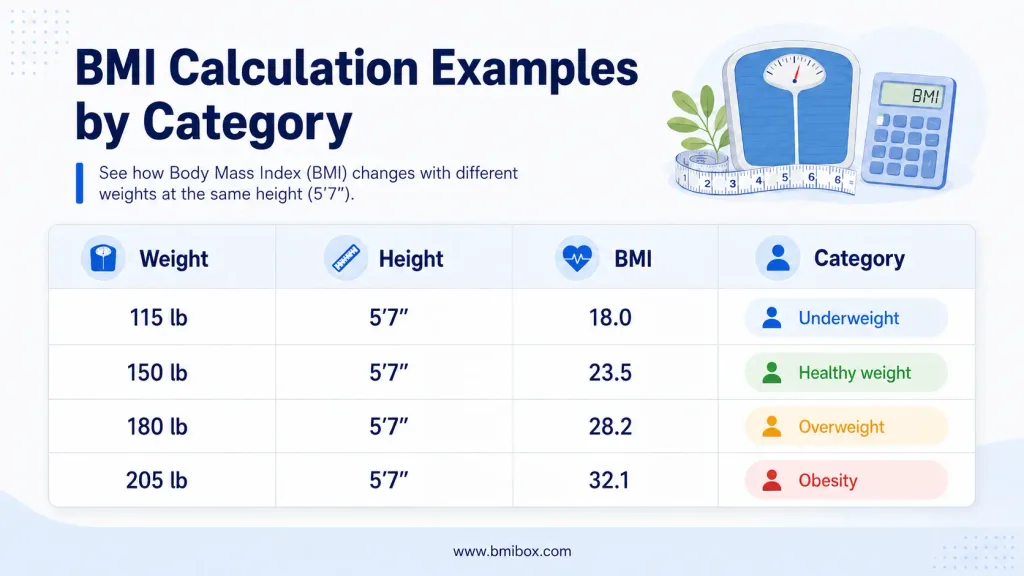
These examples are only for learning how the formula works. A BMI score does not diagnose health. It simply places weight and height into a broad adult BMI category.
What Does Your BMI Score Mean?
Your BMI score gives you a general idea of which adult weight category your height and weight fall into.
A BMI result may suggest:
- Whether your weight is below the standard adult range
- Whether your result falls in the healthy weight range
- Whether your result falls in the overweight range
- Whether your result falls in the obesity range
But BMI does not explain why your result falls in that category. It does not tell you how much body fat you have, where fat is stored, how much muscle you carry, or whether you have any health condition.
This is why BMI should be used as a starting point, not a final answer.
After getting a BMI result, people may also be asked to measure their waist, because waist size can add useful context.
What BMI Does Not Measure
BMI uses only height and weight. That makes it quick, but limited.
BMI does not directly measure:
- Body fat
- Muscle mass
- Waist size
- Fat distribution
- Bone density
- Fitness level
- Blood pressure
- Blood sugar
- Cholesterol
- Medical history
- Overall health
For example, a very muscular person may have a high BMI because muscle adds body weight. An older adult may have a BMI in the healthy range but still have lower muscle mass. Someone may also have a healthy BMI but carry more weight around the waist.
To understand these limits in more detail, read BMI limitations and where BMI can be misleading.
Who Should Be Careful When Calculating BMI?
BMI is most commonly used for adults, but it is not equally useful for everyone.
Be careful when reading BMI results if you are:
- Pregnant
- Under 20
- An athlete or very muscular
- An older adult
- Recovering from an eating disorder
- Living with a condition that affects height, weight, or fluid balance
- From a group where health risks may begin at different BMI levels
Children and teens should not use adult BMI categories. Their BMI is interpreted using age and sex percentiles, because they are still growing. The CDC child and teen BMI calculator generates BMI percentile and category for ages 2 through 19.
If your BMI result worries you, speak with a qualified healthcare professional. They can look at BMI alongside waist size, blood pressure, blood sugar, cholesterol, medical history, and other factors.
Should You Use a BMI Calculator or Calculate Manually?
Both methods work.
Manual calculation is useful when you want to understand the formula. A BMI calculator is better when you want a fast result without math errors.
Use manual calculation when:
- You are learning the BMI formula
- You want to check how BMI is measured
- You need to show a formula example
Use a calculator when:
- You want a quick result
- You want to avoid conversion mistakes
- You want to compare your result with BMI categories
You can calculate your BMI using the BMIBox calculator, then read the BMI category guide to understand your result.
Common BMI Calculation Mistakes
BMI is simple, but small errors can change the result.
Here are common mistakes to avoid:
1. Using centimeters instead of meters
For the metric formula, height must be in meters, not centimeters.
Wrong: 70 ÷ 175²
Right: 70 ÷ 1.75²
If your height is 175 cm, convert it to 1.75 m first.
2. Forgetting to square height
BMI uses height squared. That means height is multiplied by itself.
For example:
1.75² = 1.75 × 1.75
3. Forgetting the 703 in the US formula
If using pounds and inches, you must multiply by 703.
Without 703, the result will not be a correct BMI score.
4. Mixing units
Do not mix kilograms with inches or pounds with meters.
Use either:
- Kilograms and meters
- Pounds and inches
5. Treating BMI as a diagnosis
BMI is a screening tool. It can help you understand a weight category, but it does not diagnose a health condition.
How to Use Your BMI Result
After calculating BMI, use the result as a basic guide.
A practical next step is to compare your result with:
- The adult BMI chart
- Your waist measurement
- Your recent weight changes
- Your activity level
- Your blood pressure
- Your blood sugar
- Your cholesterol levels
- Your personal medical history
If your BMI is lower or higher than expected, avoid panic. A BMI score is only one number. It may be useful, but it does not tell the full story.
FAQs
How do I calculate BMI manually?
To calculate BMI manually, divide your weight by your height squared. If you use kilograms and meters, use BMI = kg ÷ m². If you use pounds and inches, use BMI = lb ÷ in² × 703. Make sure your height and weight are in the correct units before calculating.
What is the BMI formula in kg and meters?
The metric BMI formula is BMI = weight in kilograms ÷ height in meters squared. For example, if you weigh 70 kg and your height is 1.75 m, your BMI is 70 ÷ 1.75², which equals about 22.9.
What is the BMI formula in pounds and inches?
The US BMI formula is BMI = weight in pounds ÷ height in inches squared × 703. For example, if you weigh 160 pounds and are 68 inches tall, your BMI is 160 ÷ 68² × 703, which equals about 24.3.
Why do you multiply by 703 in the BMI formula?
The number 703 is used in the pounds-and-inches BMI formula to adjust the calculation for US units. The original BMI formula uses kilograms and meters. When using pounds and inches, the conversion factor helps produce a comparable BMI score.
What BMI is considered healthy?
For most adults, a BMI from 18.5 to 24.9 is usually considered the healthy weight range. BMI below 18.5 is underweight, 25.0 to 29.9 is overweight, and 30.0 or higher is obesity. BMI is still only a screening tool, not a diagnosis.
Can I calculate BMI with height in centimeters?
Yes, but you need to convert centimeters to meters first. Divide your height in centimeters by 100. For example, 175 cm becomes 1.75 m. Then use the metric formula: BMI = weight in kg ÷ height in meters².
Is BMI accurate for everyone?
BMI is not accurate for everyone. It may be misleading for athletes, older adults, pregnant adults, and people with higher or lower muscle mass. BMI does not directly measure body fat, waist size, fitness level, or overall health, so it should be read with other health factors.
Disclaimer
This content is for educational use only. It does not replace medical advice, diagnosis, or treatment. BMI is a screening tool and does not directly measure body fat, muscle mass, waist size, or overall health. Speak with a qualified healthcare professional if you have concerns about your weight, BMI, or health.
