
The BMI Formula
The BMI formula is used to calculate body mass index from a person’s weight and height. In metric units, BMI is calculated by dividing weight in kilograms by height in meters squared. In imperial units, BMI is calculated by dividing weight in pounds by height in inches squared, then multiplying by 703.
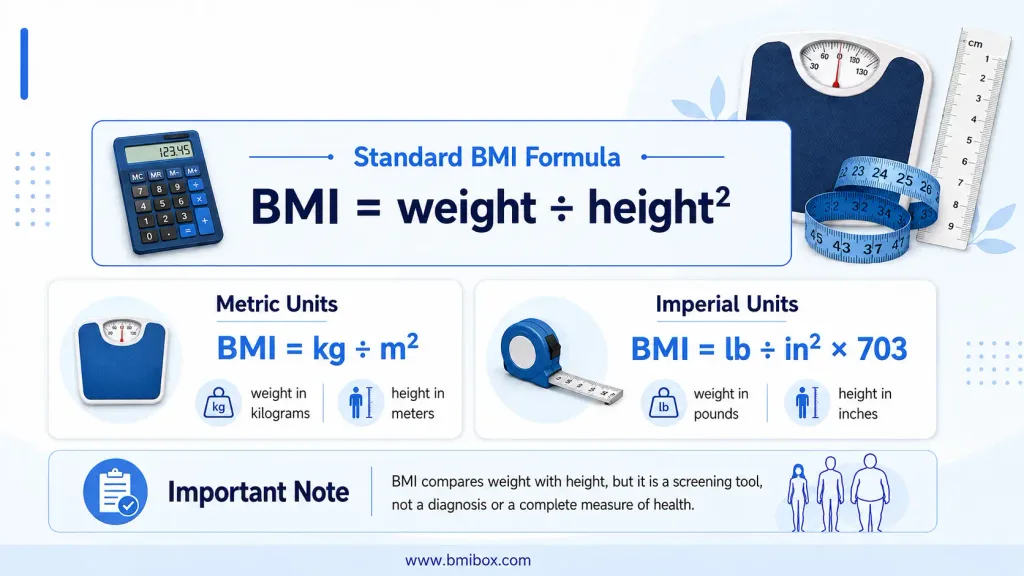
BMI is commonly used as a simple health screening tool for adults. It can help place a BMI score into a general category, such as underweight, healthy weight, overweight, or obesity. But BMI does not directly measure body fat, muscle mass, waist size, bone density, fitness level, or overall health.
The standard BMI formula is BMI = weight ÷ height². In metric units, use BMI = kg ÷ m². In imperial units, use BMI = lb ÷ in² × 703. BMI compares weight with height, but it is a screening tool, not a diagnosis or a complete measure of health.
What Is the BMI Formula?
The BMI formula is a simple equation that compares body weight with height.
There are two common versions:
| Measurement System | BMI Formula |
| Metric formula | BMI = weight in kilograms ÷ height in meters² |
| Imperial formula | BMI = weight in pounds ÷ height in inches² × 703 |
BMI is a calculated measure of body weight relative to height. For adults, BMI is categorized as underweight, healthy weight, overweight, and obesity. BMI is a screening measure and should be considered with other health factors when assessing health.
In simple words, the BMI equation asks:
How much does this person weigh compared with their height?
That is why BMI uses height squared. It adjusts weight based on height instead of looking at weight alone.
Metric BMI Formula
The metric BMI formula is:
BMI = weight in kilograms ÷ height in meters²
Use this formula when:
- Weight is measured in kilograms
- Height is measured in meters
Metric Formula Example
Let’s say someone weighs 72 kg and is 1.75 m tall.
| Step | Calculation |
| Weight | 72 kg |
| Height | 1.75 m |
| Height squared | 1.75 × 1.75 = 3.0625 |
| BMI equation | 72 ÷ 3.0625 |
| BMI score | 23.5 |
So, the BMI score is 23.5.
For adults, this falls within the healthy weight BMI range.
Imperial BMI Formula
The imperial BMI formula is:
BMI = weight in pounds ÷ height in inches² × 703
Use this formula when:
- Weight is measured in pounds
- Height is measured in inches
The number 703 is used to adjust the formula for pounds and inches.
Imperial Formula Example
Let’s say someone weighs 165 pounds and is 5 feet 9 inches tall.
First, convert height into total inches:
5 feet = 60 inches
60 + 9 = 69 inches
Now calculate BMI:
| Step | Calculation |
| Weight | 165 lb |
| Height | 69 inches |
| Height squared | 69 × 69 = 4,761 |
| Divide weight by height squared | 165 ÷ 4,761 = 0.03465 |
| Multiply by 703 | 0.03465 × 703 |
| BMI score | 24.4 |
So, the BMI score is 24.4.
For adults, this falls within the healthy weight BMI range.
To avoid conversion mistakes, you can use our BMI calculator and then compare your result with the adult BMI categories.
Why Is Height Squared in the BMI Equation?
BMI uses height squared because body weight usually increases as height increases. A taller person can naturally weigh more than a shorter person without having the same body size or body composition.
If BMI used height only once, the result would not adjust weight enough for height. Squaring height helps make the weight-to-height comparison more useful across adults of different heights.
For example, a person who weighs 170 pounds may have a different BMI depending on height:
| Weight | Height | Approx. BMI |
| 170 lb | 5’4″ | 29.2 |
| 170 lb | 5’8″ | 25.8 |
| 170 lb | 6’0″ | 23.1 |
The weight is the same, but the BMI changes because height changes.
This is why BMI is not just a weight number. It is a weight-and-height calculation.
How to Convert Height for the BMI Formula
The most common BMI formula mistake is using the wrong height unit.
If Using Metric Units
Height must be in meters, not centimeters.
To convert centimeters to meters:
centimeters ÷ 100 = meters
| Height in cm | Height in m |
| 160 cm | 1.60 m |
| 165 cm | 1.65 m |
| 170 cm | 1.70 m |
| 175 cm | 1.75 m |
| 180 cm | 1.80 m |
Example:
175 cm ÷ 100 = 1.75 m
Then use:
BMI = kg ÷ m²
If Using Imperial Units
Height must be in total inches, not feet and inches separately.
To convert feet and inches:
feet × 12 + extra inches = total inches
| Height | Total Inches |
| 5’0″ | 60 |
| 5’3″ | 63 |
| 5’6″ | 66 |
| 5’9″ | 69 |
| 6’0″ | 72 |
| 6’3″ | 75 |
Example:
5’9″ = 5 × 12 + 9
5’9″ = 69 inches
Then use:
BMI = lb ÷ in² × 703
BMI Formula Examples
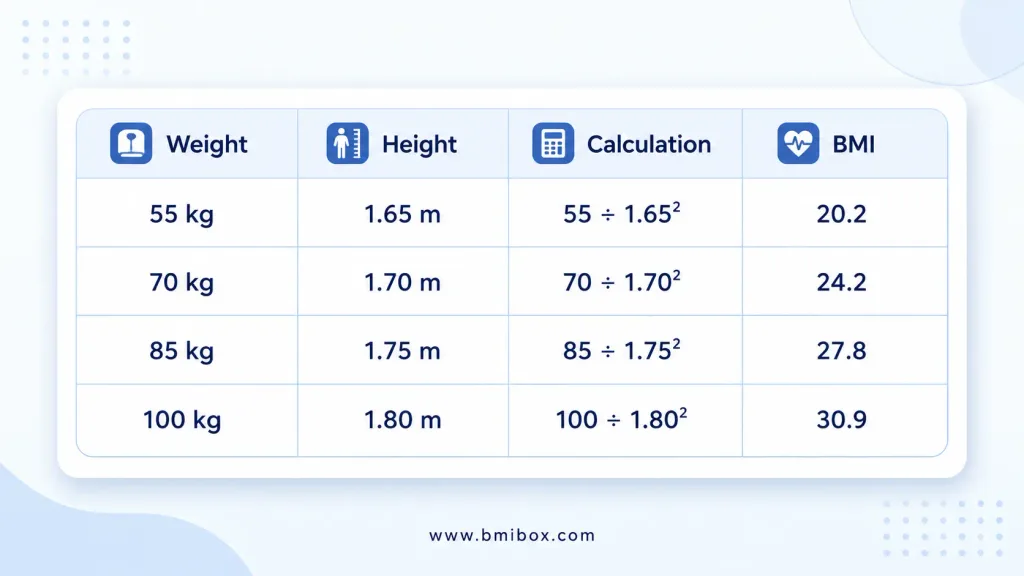
Here are a few simple examples using both formulas.
Metric Examples
Imperial Examples
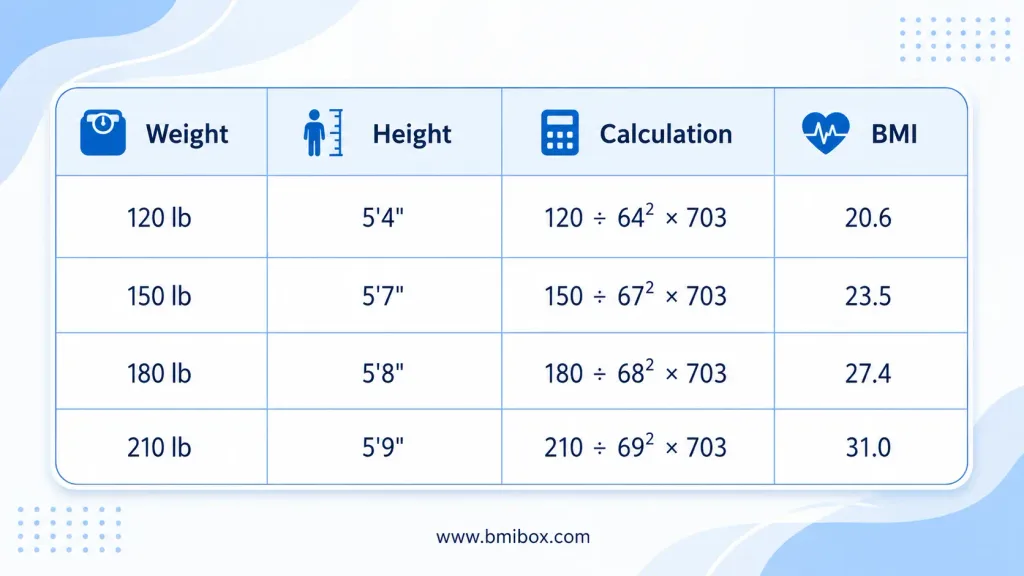
These examples are for learning how the BMI equation works. They do not diagnose health or show body composition.
What the BMI Formula Measures
The BMI formula measures weight relative to height. It does not measure body fat directly.
That makes BMI useful for general screening, especially across large adult populations. The CDC describes BMI as a quick, low-cost screening measure for underweight, overweight, or obesity, and says it is also valuable as a population health measure.
BMI may help with:
- Understanding a general adult weight category
- Comparing weight status across groups
- Screening for possible underweight, overweight, or obesity
- Tracking broad weight category changes over time
- Starting a conversation about health factors
But BMI should not be used alone to judge a person’s health.
What the BMI Formula Does Not Measure
BMI is limited because it only uses weight and height.
BMI does not directly measure:
- Body fat
- Muscle mass
- Bone density
- Waist size
- Fat distribution
- Fitness level
- Blood pressure
- Blood sugar
- Cholesterol
- Medical history
- Overall health
BMI is not a direct measure of body fat and cannot distinguish fat mass from lean body mass such as muscle and bone. It also does not show where fat is located in the body.
This is why someone with high muscle mass may have a higher BMI without having high body fat. It is also why someone can have a BMI in the healthy weight range but still have other health risk factors.
To understand these limits better, read BMI limitations and BMI vs body fat percentage.
Common BMI Formula Mistakes
BMI is easy to calculate, but a few small mistakes can change the result.
Using Centimeters Instead of Meters
For the metric formula, height must be in meters.
Wrong:
70 ÷ 175²
Right:
70 ÷ 1.75²
If your height is 175 cm, convert it to 1.75 m before calculating.
Forgetting to Square Height
BMI uses height squared.
That means:
1.75² = 1.75 × 1.75
It does not mean 1.75 × 2.
Mixing Measurement Systems
Do not mix kilograms with inches or pounds with meters.
Use one complete formula:
- Kilograms with meters
- Pounds with inches
Forgetting the 703 Factor
If using pounds and inches, the formula needs × 703.
Without 703, the BMI score will be incorrect.
Reading BMI as a Diagnosis
BMI is not a medical diagnosis. It is a screening tool. A BMI result should be considered with other factors, especially if the number is very low, very high, or does not match your body type.
Metric vs Imperial BMI Formula
Both formulas measure the same thing. The only difference is the unit system.
| Feature | Metric BMI Formula | Imperial BMI Formula |
| Weight unit | Kilograms | Pounds |
| Height unit | Meters | Inches |
| Formula | kg ÷ m² | lb ÷ in² × 703 |
| Common use | Most countries | United States and some US-based tools |
| Result | BMI score | BMI score |
The final BMI score can be compared with the same adult BMI category ranges.
For example, a BMI of 24 means the same adult category whether it was calculated with metric units or imperial units. The formula changes only because the units are different.
Is the BMI Formula Accurate?
The BMI formula is useful, but it is not perfect.
For many adults, BMI gives a general idea of weight category. But it may be less accurate for people whose body composition differs from the average adult.
BMI may be misleading for:
- Athletes
- Very muscular adults
- Older adults
- Pregnant adults
- Some ethnic groups
- People with medical conditions affecting weight or fluid balance
- People recovering from eating disorders
BMI should also be used carefully for children and teens because adult BMI ranges do not apply to them.
The best way to use BMI is to treat it as a starting point. It can help you understand a broad category, but it should be considered alongside waist size, blood pressure, blood sugar, cholesterol, activity level, medical history, and professional guidance.
How to Use the BMI Formula Safely
Use the BMI formula to understand your result, not to judge your health.
A safer way to use BMI is:
- Calculate your BMI.
- Compare it with the adult BMI categories.
- Read the result as a screening number.
- Consider other measurements, such as waist size.
- Speak with a qualified healthcare professional if the result concerns you.
You can calculate your BMI with the BMIBox calculator, then use the BMI category chart to compare your result.
Disclaimer
This content is for educational use only. It does not replace medical advice, diagnosis, or treatment. BMI is a screening tool and does not directly measure body fat, muscle mass, waist size, or overall health. Speak with a qualified healthcare professional if you have concerns about your weight, BMI, or health.
